
The Polegreen Story

Where Religious Freedom Began in Virginia
Polegreen Church was ground zero for the fight for religious liberty in colonial America and it changed the course of our nation's history.
Did You Know?
- Patrick Henry learned to be an orator here, worshipping alongside his mother for 12 years
- The first African American spiritual was created at Polegreen: “Lord, I want to be a Christian in my Heart”
- America's first hymn writer served as pastor here
- The church survived 120 years of revolution and war, only to be destroyed in 1864 by tragic friendly fire
The Beginning: When Faith Was Illegal
1607-1730s: One Church, One Rule
For 170 years, Virginia had only one legal religion: the Anglican Church. The colonial government built the churches, paid the clergy, and taxed everyone whether they agreed or not. All other faiths were actively suppressed.
1739: A Spark Ignites
When British evangelist George Whitefield preached in Williamsburg, his message spread like wildfire. A Hanover County brick mason named Samuel Morris did something radical: he began gathering neighbors in his home on Sunday afternoons to read the Bible and Whitefield's sermons.
This was the beginning of Virginia's religious freedom movement.
1743: The First Victory
After years of meeting in secret, four “reading houses” were officially licensed as the first legal non-Anglican gathering places in Virginia. The one on Morris' land was named after George Polegreen, a previous landowner.
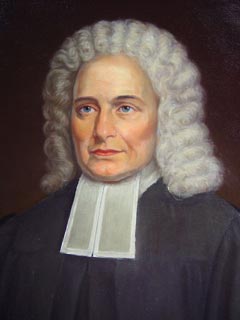 Reverend Samuel Davies
The Samuel Davies Era (1747-1759)
The Man Who Changed Everything
At just 23 years old, Reverend Samuel Davies arrived from Pennsylvania as the first non-Anglican minister ever licensed to preach in Virginia. Over the next 12 years, he became a force of nature:
As an Educator:
- Pioneered education for enslaved people
- Created the first American hymns and poetry
- Published widely, spreading ideas throughout the colonies
As a Patriot:
- Became “the best recruiter in the Colony” during the French and Indian War (according to Governor Dinwiddie)
- Inspired a generation of revolutionary leaders
As an Orator:
- Had “no peer as a pulpit orator in Virginia or perhaps in all the colonies”
- Personally mentored young Patrick Henry, who later said Davies taught him “what an orator should be”
For Students & Educators
Connect to Your Curriculum:
- American Revolution: Religious freedom as a founding principle
- Civil Rights: Early efforts in racial equality and education
- Literature & Music: Origins of American hymnody and spiritual traditions
- Public Speaking: Patrick Henry's rhetorical training ground
- Colonial History: Life in pre-Revolutionary Virginia
The Civil War Tragedy
May 29, 1862: Documented
 Interior of Historic Polegreen Church. Drawing by Lieutenant Thomas M. Farrell, 1862.
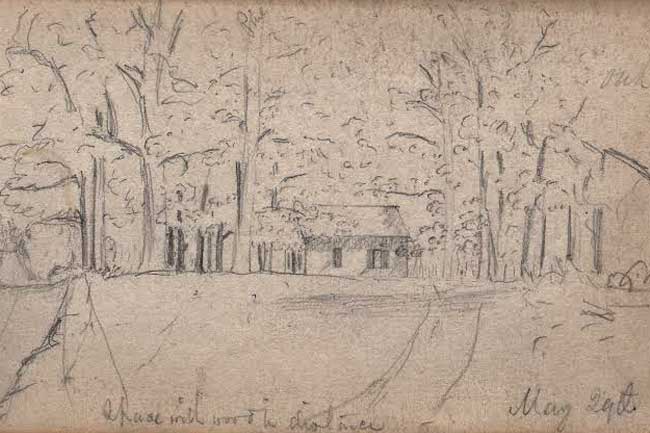 Exterior of Historic Polegreen Church. Drawing by Lieutenant Thomas M. Farrell, 1862.
Union Lieutenant Thomas M. Farrell sketched the church while on reconnaissance. His drawings are the only surviving images of the original structure. (His great-grandson discovered them decades later while cleaning a basement!)
May 1864: Destroyed
During Grant's attempt to break through Lee's lines at Totopotomoy Creek, Union forces occupied Polegreen Church as a strategic position. Confederate artillery fired to dislodge them.
The heartbreaking irony: The Confederate gunner whose shot set the church ablaze was William S. White. His own father had been baptized at Polegreen.
1864-Present: Lost and Found
The war-ravaged congregation couldn't afford to rebuild. Over the decades, all physical traces vanished. But the story and the legacy survived.Why Polegreen Matters Today
This isn't just local history. Polegreen Church represents:
- The birth of religious freedom in America
- The power of peaceful resistance to unjust laws
- Early efforts toward racial equality in education
- The training ground of Revolutionary leaders
- A bridge between colonial and modern America
The Pine Slash Story
Pine Slash: Patrick Henry's Honeymoon Cottage
Hanover County, Virginia | c. 1750 | National Register of Historic Places
Pine Slash, Patrick Henry's "Honeymoon Cottage" (circa 1750), reveals the personal side of America's most famous freedom advocate. It is recognized as an original home associated with Patrick Henry.
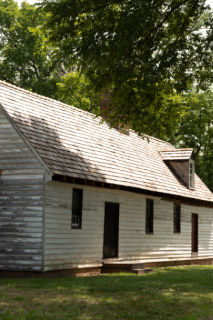 Pine Slash, exterior
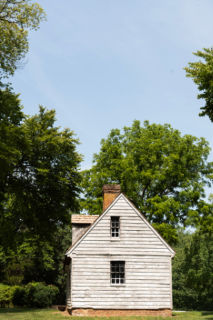 Pine Slash, exterior
A Wedding Gift and a New Beginning
Pine Slash was the first home of Patrick Henry and his bride, Sarah Shelton. A manor house and 316 acres in Hanover County were given to Henry and Sarah by her family on the occasion of their marriage. In October 1754, at the age of eighteen, Henry married Sarah Shelton, a seventeen year old from Rural Plains, not far from Studley. He received as her dowry a 316 acre The house was almost immediately destroyed by fire, and the couple moved into a cottage on the property. The Henrys lived here for about six months.
Architectural Significance
The original circa 1750 core of the cottage is built using rare colonial vertical plank construction, a vernacular method using heavy planks roughly 2 to 2.5 inches thick and 6 to 12 inches wide, set side by side and tenoned into hewn sills, corner posts, plates, and diagonal braces joined with pegged mortise and tenon joints. These self supporting plank walls are chamfered at the joints and covered with battens, forming the building's primary structure, with the interior left exposed and planed to create a paneled appearance. This technique was uncommon in the Chesapeake region but practical for timber rich frontier settings, prioritizing rapid assembly and economy through abundant local pine sawn on site.
The original one and a half story dwelling consists of a hall and chamber on the ground floor divided by a plank partition, two small attic rooms reached by an enclosed corner staircase, and a half cellar beneath the north end accessed from outside. The roof employs pit sawn rafters resting on a false plate and joined at the ridge without a central beam, now covered in standing seam metal. A single interior chimney served the chamber, reflecting the modest heating needs of this unpretentious layout, with heart pine used throughout for framing, planking, and rafters.
What makes Pine Slash exceptional today is how much of this rare fabric survives intact. A 2010 architectural study by Edward Chappell, then Roberts Director of Architectural and Archaeological Research at the Colonial Williamsburg Foundation, examined the cottage's hewn sill foundation and pegged mortise and tenon joints, comparing its lapped, nailed plank walls to a small handful of regional survivors and identifying Pine Slash as the sole known Virginia example of this mid 18th century building technique. Surviving hardware, including wrought iron strap hinges and wooden box locks, further attests to the building's 18th century craftsmanship.
Listing on the Virginia Landmarks Register in 1986 and the National Register of Historic Places in 1987 was based specifically on this rare vertical plank construction and the building's association with Henry's early colonial farming life, and the designation placed the property under a preservation easement administered by the Virginia Department of Historic Resources, restricting alterations to protect its structural integrity and historic fabric. Subsequent stabilization work, including parging of brick foundations, replacement of most sills and floor joists, and renewal of weatherboarding, has preserved the intact interior plank walls and original hardware without introducing modern plumbing or extensive electrical systems. Two small sections of plank wall have been replaced with modern stud framing where rot made the original material unsalvageable, but these targeted repairs were designed to retain the core plank framework and interior elements needed to meet National Register authenticity standards.
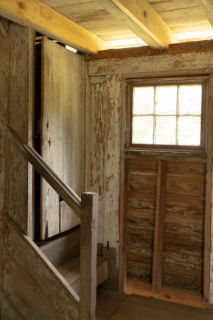 Pine Slash, interior
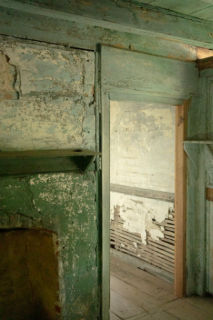 Pine Slash, interior
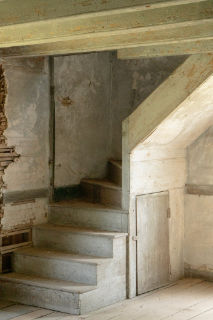 Pine Slash, interior
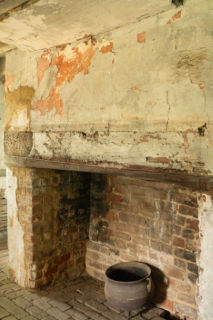 Pine Slash, interior
Today
The Road to Revolution Heritage Trail links the historic sites and institutions in Virginia that interpret the life and legacy of Patrick Henry, with Pine Slash designated as Stop 4 on the statewide trail, marked near Mechanicsville in Hanover County. HPCF has developed a fully fact checked docent tour script that brings the cottage's story to life for visitors, opening with an invitation to notice the wooden building that has been quietly standing on the ground since the mid eighteenth century.
HPCF's Work to Interpret Pine Slash
HPCF stewards Pine Slash as part of a five acre campus that also includes the restored Prospect Hill manor house (circa 1830) and period carriage outbuildings, positioning the honeymoon cottage as the emotional centerpiece of the site's interpretive story. To ensure restoration meets the highest standards of historical accuracy, HPCF engaged preservation consultant Gordon Lohr, whose 25 plus year connection to Pine Slash and expertise in period appropriate restoration techniques signals HPCF's commitment to historical authenticity and alignment with DHR preservation standards for this circa 1750 Patrick Henry honeymoon cottage. Meetings with Lohr formalized HPCF's commitment to preserving this rare example of 18th century building techniques and outlined how this preservation effort advances the foundation's educational mission, with particular attention to the cottage's distinctive vertical plank construction.
The Studley Story
Studley: Birthplace of Patrick Henry
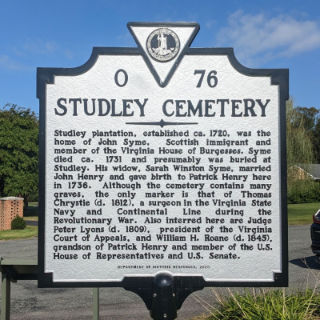 Historical Marker: Studley Cemetery
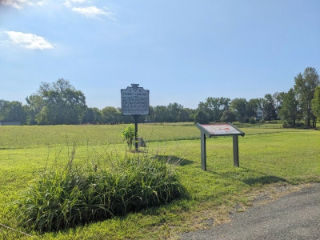 Studley Historical Marker
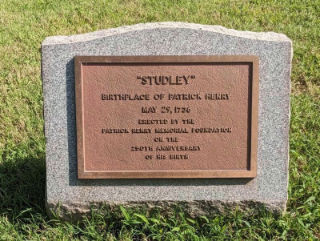 Stone Marker: 'Studley' Birthplace of Patrick Henry
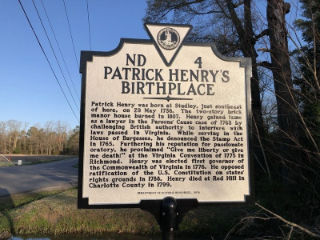 Historical Marker - 'Patrick Henry's Birthplace'
Hanover County, Virginia | c. 1720s | National Register of Historic Places
Nestled in eastern Hanover County where modern residential communities meet farm fields worked for centuries, Studley stands as the site of the colonial-era plantation home where Patrick Henry, the "Voice of the Revolution,”was born.
Origins of the Property
Studley, a 600-acre tobacco plantation included a Manor house built in the 1720s by Colonel John Syme for his second wife, Sarah Winston Syme. Following Colonel Syme's death in 1731, Sarah became a widow and remarried shortly thereafter. Her new husband was a Scottish immigrant named John Henry. John Henry quickly became a respected member of the community, working as a surveyor and mapmaker, serving as a colonel of the militia, and eventually becoming justice of the peace for Hanover County.
Birth of a Revolutionary
Patrick Henry was born at Studley on May 29, 1736, The second Henry child born at Studley. Patrick spent his early childhood on the 600-acre farm with an older stepbrother, an older brother, and seven younger sisters. Patrick Henry attended a local school until the age of ten and also received instruction from his father in classics and theology. A childhood friend remembered his affinity for music and recalled that Henry could often be found "lying under the shade of some tree" observing the natural world. According to his father’s will, when Patrick’s Step-brother, John Syme, Jr. came of age, he received his father’s lands and became owner of Studley as well as all of his father’s acreage. Studley then became the property of John Syme II. John Henry and his wife Sarah Winston Syme then moved their young family, including Patrick, to a new home called Mount Brilliant in western Hanover County.
The Plantation and Its People
Archaeological excavations and surviving insurance maps for Studley show that by 1796 the main 40-by-30-foot brick structure stood two stories high with a one-story brick wing and an attached porch. It was surrounded by a variety of outbuildings including a kitchen, dairy, study, stables, barn, and granary. Mainly through the work of Studley's enslaved population, both John Henry and his predecessor John Syme raised tobacco on the plantation and exported it to English markets. The partially cured tobacco leaves were packed tightly in large hogsheads and shipped from nearby Page's Warehouse on the Pamunkey River.
Loss and Legacy
The Studley Manor house was destroyed by fire in 1807, and now only archaeological remnants remain. In 1995, Preservation Virginia purchased the property to ensure its protection and preservation. The site was listed on the National Register of Historic Places in 1982. Scientific excavation of the Patrick Henry's Birthplace Archaeological Site could yield new insights into the early life of the noted patriot. Today, the site is interpreted through a Road to Revolution historical marker near the archaeological footprint at 9620 Studley Farms Drive.
The Man Who Shaped a Nation
Henry was the first elected governor of Virginia, a devoted father of 17 children, and the most famous orator of his day. His 1765 resolutions against the Stamp Act articulated the basic principles of the American Revolution. Henry is perhaps best known for his immortal words "Give me liberty or give me death," which he delivered during the Second Virginia Convention at St. John's Church in 1775. His impassioned words helped move colonists toward American independence. Henry's political career included 26 years of service in the Virginia legislature and five terms as governor. He helped draft the Virginia Constitution of 1776.
HPCF's Work at Studley
As steward of Studley and two other National Register-listed properties in Hanover County, the Historic Polegreen Church Foundation (HPCF) is working to ensure that this archaeological landscape becomes a destination worthy of its national significance. HPCF's development plan for the site envisions two independent phases: an initial preservation and interpretation layer, and a longer-term active archaeological field school program, with each phase designed to stand alone and deliver value regardless of whether the other is ever implemented. Phase 1 calls for a professional archaeological survey and documentation of all known foundation areas, protective measures over identified features, interpretive posts with plaques, simple gravel pathways, and a QR code system linking visitors to digital historical content, transforming what is today an open field into a navigable, educational experience. With America's semiquincentennial underway, HPCF is committed to ensuring that Studley takes its rightful place in the story of how liberty in America began.
.png)
Top of Page

Copyright © 2018 by Historic Polegreen